
The Cameron Award, from the RCSI School for Population Health, honors Professor Agnes Binagwaho for her transformative work rebuilding Rwanda’s health system and advancing equitable healthcare access in resource-limited settings worldwide.

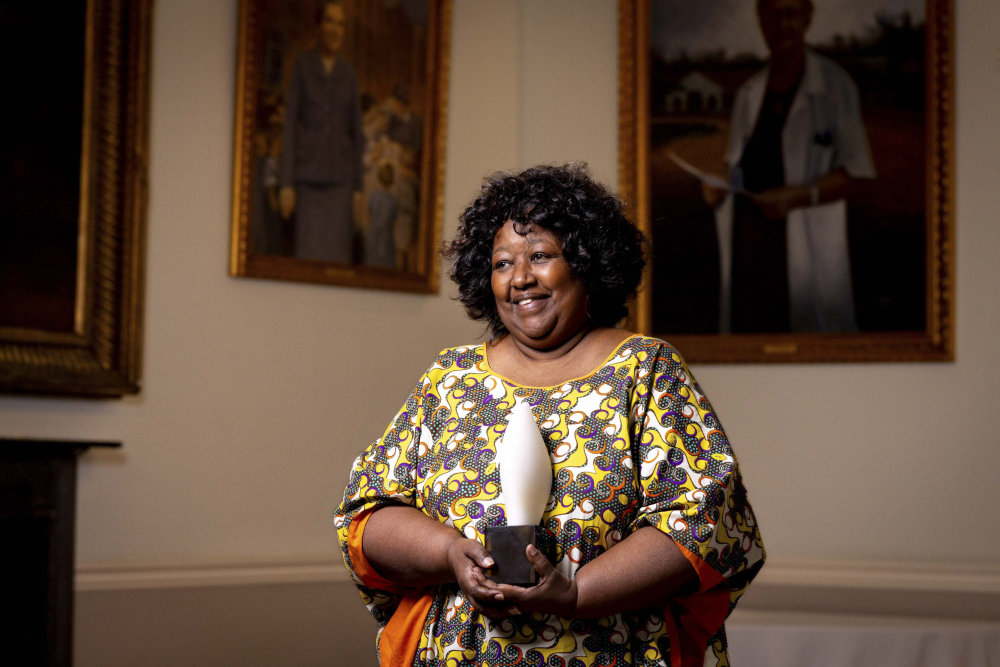
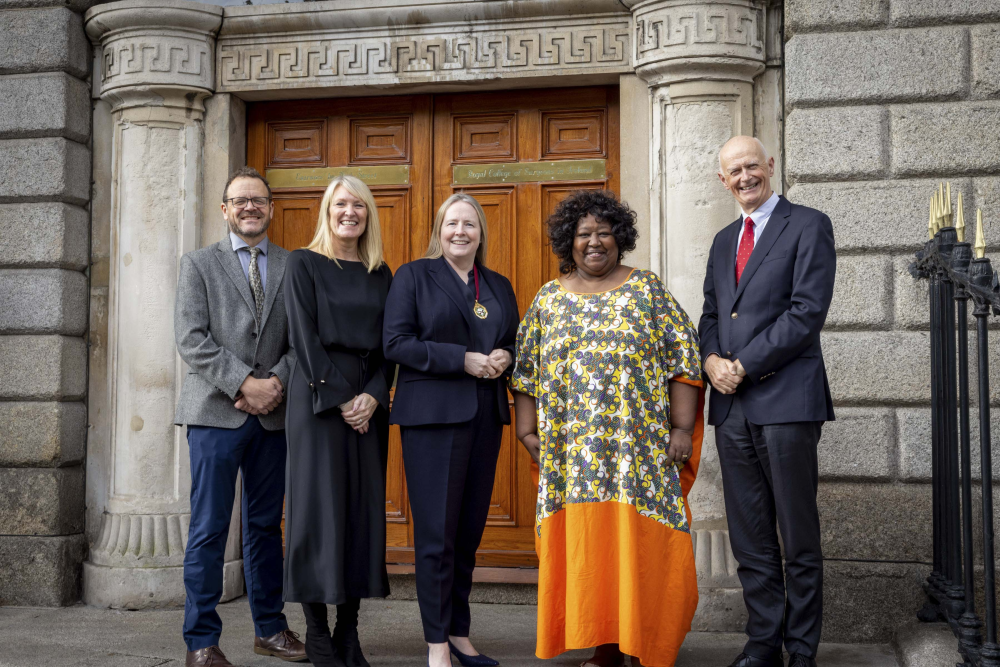
On November 3, 2025, Professor Agnes Binagwaho was presented the Cameron Award for Population Health from RCSI University of Medicine and Health Sciences. She was recognized for her decades of work that transformed healthcare delivery in Rwanda and influenced global approaches to health equity. The award, which commemorates Sir Charles A. Cameron’s pioneering public health reforms in 19th-century Dublin, acknowledges leaders whose contributions advance health equity and strengthen health systems.
Transforming a Broken Health System
Professor Binagwaho, a Rwandan pediatrician, returned to her country in 1996, two years after the genocide against the Tutsi that killed more than one million people. She found a devastated health system. Over the following two decades, she held senior government positions—Executive Secretary of the National AIDS Control Commission, Permanent Secretary of the Ministry of Health, and Minister of Health for five years—helping to rebuild the country’s health infrastructure from the ground up.
The transformation of Rwanda’s health system under her leadership stands as a model for resource-limited countries. Health insurance coverage expanded from 43% in 2005 to over 90% of the population. This was achieved through a community-based insurance model where contributions were scaled to ability to pay, with the government subsidizing care for the poorest citizens. This system was designed with equity in administration, equity in geographic access, equity for gender access and age access as foundational principles.
The approach prioritized geographic distribution of health facilities and trained personnel, ensuring that rural and remote areas received services comparable to urban centers. Health centers were planned at a ratio of one per 25,000 inhabitants, with staffing levels standardized across regions. This prevented the concentration of resources in cities and reduced the need for people to travel long distances for care.
Care Within and Beyond Rwanda
Prof. Binagwaho has consistently emphasized evidence-based policymaking throughout her career. She co-chaired the Millennium Development Goal Task Force on HIV/AIDS and Access to Essential Medicines, addressing one of the century’s most pressing health challenges. Her academic work includes over 250 peer-reviewed publications focused on strengthening healthcare delivery in resource-constrained environments.
In 2015, she co-founded the University of Global Health Equity in Rwanda with Partners In Health. They created an institution designed to train health professionals differently, by integrating clinical excellence with attention to social determinants of health and systems thinking. She served as the university’s vice chancellor until 2022. She maintains academic appointments at Harvard Medical School and Dartmouth’s Geisel School of Medicine.
Her governance roles reflect the breadth of her influence: she serves on the boards of the Rockefeller Foundation, the African Europe Foundation, the Cummings Foundation, and the African Union Commission for Infectious Diseases Response. She is a member of the U.S. National Academy of Medicine, the World Academy of Sciences, and a fellow of the African Academy of Sciences. In 2022, she received the L’Oréal-UNESCO Award for Women in Science.
Bringing Health Equity to the World
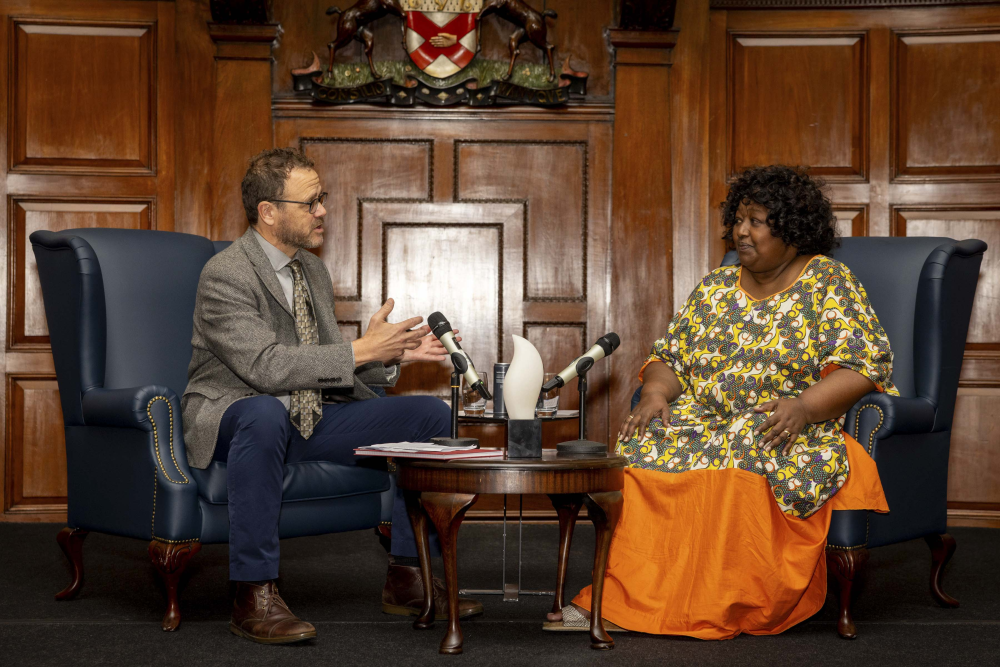
At her lecture at the award ceremony in Dublin, Professor Binagwaho said, “Community engagement is the cornerstone of meaningful progress in health equity and the strengthening of health systems. In Rwanda and across sub-Saharan Africa, the most successful health programmes share a common foundation: genuine community buy-in. Building resilient health services depends on trust and demystifying health sciences within our communities is an essential part of that process.”
This principle of participatory process—involving communities in the design and implementation of health systems—runs through all her work. In a podcast interview with Northwestern University, she explained that Rwanda’s health transformation succeeded because “the population is contributing to building the system. They trust the system because they understand it.”
Professor Cathal Kelly, Vice Chancellor of RCSI, said “Professor Agnes Binagwaho exemplifies the values of equity, compassion and global collaboration that we celebrate through the Cameron Award for Population Health. Her leadership in rebuilding and reimagining Rwanda’s health system, and her commitment to educating the next generation of healthcare professionals, serve as an inspiration to all of us working to advance population health worldwide.”
The Cameron Award joins a list of recognitions that includes the 2015 Roux Prize for using Global Burden of Disease data to reduce infant mortality in Rwanda and inclusion among the 100 Most Influential African Women for 2020-2021. Previous Cameron Award recipients include Dr. Mike Ryan of the World Health Organization and Professor Andrew Morris, Director of Health Data Research UK.
Measurable Improvement in Health Through Equity
Professor Binagwaho’s career demonstrates how clinical expertise combined with policy leadership and commitment to equity can produce measurable improvements in population health. Her work addresses a challenge familiar to many low- and middle-income countries: how to build robust health systems when resources are limited and infrastructure has been damaged or destroyed. The Rwanda model—emphasizing geographic equity, community participation, evidence-based decision-making, and progressive financing—offers concrete approaches that other nations can adapt to their contexts.
RCSI’s School of Population Health continues this legacy through research addressing challenges from air pollution to diabetes, both in Ireland and internationally, maintaining the institution’s commitment to the United Nations’ third Sustainable Development Goal focused on health and well-being.
In her Northwestern interview, Professor Binagwaho reflected on what other countries might learn from Rwanda’s experience: “If you build a system based on equity in administration, equity in geographic access, equity for gender access and age access, it will work for everybody. And also involve the population in what you do so that you create trust.”
This insistence on equity as the foundation, not as an afterthought, distinguishes her approach and explains much of its success. Her work demonstrates that limited resources need not prevent the delivery of quality healthcare when systems are designed with equity as the organizing principle, and when communities are genuine partners in the process.
This summary is based on the following articles:
- Professor Agnes Binagwaho receives Cameron Award for Population Health
- Professor Agnes Binagwaho Honored with Cameron Award for Excellence in Population Health, from Science Magazine
- Professor Agnes Binagwaho receives Cameron Award for Population Health, from RCSI University of Medicine and Health Sciences
- Transforming Healthcare in Rwanda with Agnes Binagwaho, MD, PhD (podcast transcript), from the Robert J. Havey, MD Institute for Global Health
Related Articles

From Shelter Bed to Healthcare Bridge: Jean de Dieu Mukunzi’s Journey
From a homeless shelter to founding a nonprofit serving thousands: Jean de Dieu Mukunzi built Ebenezer Healthcare Access to help fellow immigrants navigate the healthcare system he once struggled to access himself.
Rwanda is Knocking on Every Door in a Bid to End Cervical Cancer
Getting over the cervical cancer elimination line means both vaccinating girls and screening women. Rwanda’s corps of volunteer health workers are going door to door to get it done. From Gavi, the Vaccine Alliance.
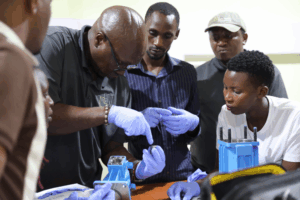
Biomedical Engineering Training Center Takes Off
Build Health International’s new training center in Kigali, Rwanda, is teaching biomedical engineers and technicians how to keep oxygen systems and life-saving medical equipment running in hospitals across East Africa.