
Amira never told her mother she had joined Sudan’s Emergency Response Rooms. Each morning she secretly crossed the frontline in North Kordofan state, entering territory held by the Rapid Support Forces—paramilitaries responsible for war crimes, including genocide—to counsel women and children who had been raped. At nightfall, she crept back to army-controlled land.
“You have to sneak in and hope you make it back,” she told the Guardian during a recent visit to London arranged by the UK Foreign Office.
Since war erupted between rival military factions in April 2023, Sudan has become the world’s worst humanitarian crisis. More than 400,000 people are believed dead, 12 million have fled their homes, and 21.2 million face acute food insecurity. State institutions have collapsed. International aid organizations struggle to reach many areas.
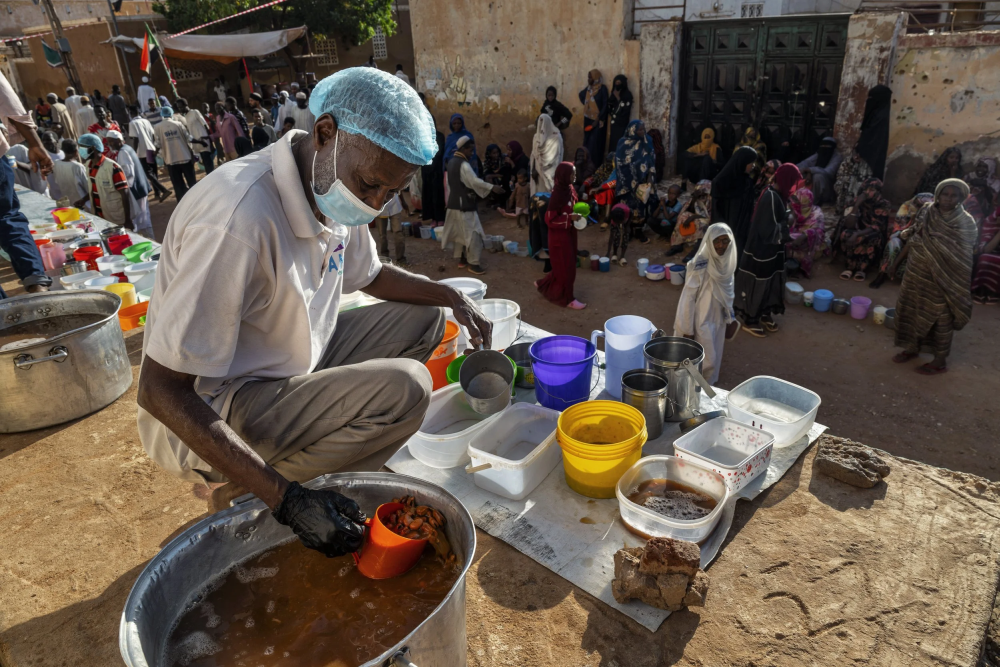
Into this catastrophe, ordinary Sudanese citizens have built something remarkable. The Emergency Response Rooms, a decentralized network of 26,000 volunteers operating in 96 of Sudan’s 118 districts, now function as a de facto replacement for the collapsed state. More than 29 million people have received meals or assistance from ERR volunteers.

The work is extraordinarily dangerous. Both the army and the RSF view the volunteers with suspicion. At least 145 have been killed. About 100 are currently detained in Shala prison in El Fasher. Volunteer Alsanosi Adam, one of the few willing to be publicly identified, described the range of threats to the Guardian: “You risk anything from intimidation to death. From torture to being killed—and anything in between.”
Jamal, another volunteer, was arrested and tortured while distributing food to starving civilians. He told the Guardian, “I was beaten and confined to a very small room which wasn’t well ventilated at all. They were accusing me of collaborating with outside forces.” He believes he would still be detained, or dead, if local residents had not rallied to protest his arrest.
The ERRs build on nafeer, a Sudanese tradition of collective support in times of hardship, and on the neighborhood resistance committees that organized protests during the 2018-2019 revolution against Omar al-Bashir. The network has united communities across ethnic and regional divisions, transcending the schisms exploited by the warring parties.

Despite their effectiveness, the ERRs operate at a 77% funding deficit. They have received less than 1% of international aid funding for Sudan, even though they deliver assistance at a fraction of the cost of UN agencies. After American aid was frozen this year, hundreds of community kitchens were forced to close.
The network was nominated for the 2025 Nobel Peace Prize. When they didn’t win, volunteers said they didn’t mind. “We only want to help,” said Jamal. But he noted that international recognition serves another purpose: “Winning it would contribute to the volunteers gaining more protection.”
Amira eventually told her family what she had been doing. “I started being more open with my mother about what I was really doing,” she told the Guardian. “To my relief, she was 100% supportive. She could not be more proud.”
Watch this video of Alsanosi Adam accepting an award for the Emergency Response Rooms:
This summary is based on the following articles:
- ‘You sneak in and hope you make it back’: the Sudanese volunteers risking it all to bring care to millions, by Mark Townsend for The Guardian
- ‘Deeply inspiring and humbling’: how neighbourhoods in Sudan are coming together to fill gaps left by foreign aid, by Kaamil Ahmed for The Guardian
Related Articles
A Chicago Surgeon Treats Children Caught in Sudan’s Drone War
As Sudan’s civil war passes 1,000 days, a Chicago surgeon working with MedGlobal describes operating on children wounded by drone strikes and encountering suffering that rivals any conflict zone he has seen.
Three Organizations Offering Cost-Effective Ways to Save Lives
Nicholas Kristof’s 2025 giving guide highlights nonprofits responding to Sudan’s humanitarian crisis, preventable tropical diseases, and vision impairment in U.S. schools.
Steadfast Care Amid Sudan’s Devastation: Dr. Jamal Eltaeb Receives Aurora Prize
Dr. Jamal Eltaeb has been awarded the 2025 Aurora Prize for Awakening Humanity for keeping Al Nao Hospital operating as one of the last functioning facilities in greater Khartoum despite bombardment, shortages, and Sudan’s collapsing health system.