
Vaccinators Harrison Moore and Jerry Karn ford rivers, navigate potholed, mud-slick roads, and do it all without pay.
by Tina S. Mehnpaine
First published November 11, 2025 by Gavi, the Vaccine Alliance
As dusk settled on the mountains over Nimba county’s Sehtontuo town, women gathered under a communal palava hut, their children in tow. All of the children had missed out on a dose or more of their scheduled vaccines and today, they were due to catch up.
The mothers, most of them farmers, had stayed home for the day, after the local Community Health Assistant (CHA) had told them that the vaccinators would be coming to town.
Harrison Moore, one of two vaccinators assigned to the Goagortuo Clinic, a health facility that serves Sehtontuo town and six other communities – duly arrived that morning on the back of a motorbike. Now he was hurriedly collecting the children’s ‘passports’ – their vaccination cards – to check names, dates and the antigens due. Most of the mothers couldn’t read, he explained, so he needed to help them out.
On outreach days, Moore’s insulated cooler box is stocked with doses of all the childhood vaccines provided by the Liberian government, including the cancer-blocking human papillomavirus (HPV) vaccine, in order to be prepared to address whatever immunity gaps he may find.
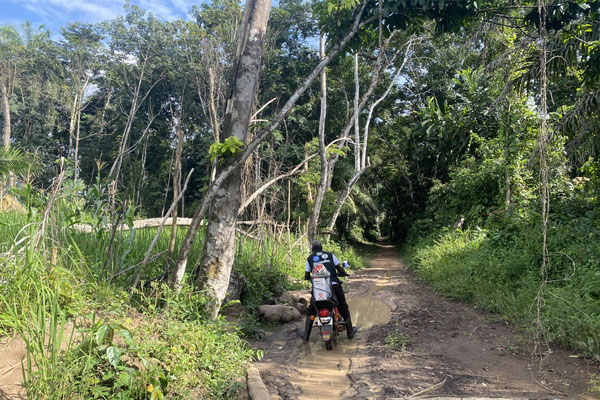
The journey here had taken four hours, jolting through dense forests and over rugged, muddy roads, and he wasn’t done yet. On outreach days like this one, Moore typically tries to make it to seven such communities. “It’s risky and tiring,” he admitted. “But because we have passion, we have to continue.”
Remote, but not forgotten
“This outreach will help to curtail some diseases in the community,” Moore said confidently.
Sehtontuo is one of Liberia’s poorest communities. Residents survive by farming, hunting or fishing, living off the forest or the creek.
The only road in and out is accessible exclusively by foot or motorbike – and that, not always. “The challenge is the road condition,” Moore says. “During the rainy season it can be hard for us to visit most of those communities.”
Sehtontuo is also close to the border with Guinea, which can ironically create the opposite challenge: high population mobility. Kou Suah, a rice farmer and gardener originally from Guinea, fell behind on her son’s vaccine schedule after travelling over the border to visit family. The child, whose father is a Liberian from Sehtontuo town, had been overdue for doses of yellow fever and measles vaccine when Moore arrived to remedy that. “Thank God for the vaccinators,” she said, promising to be present for her son’s last dose of the measles vaccine.
Meetings like this one, under the community palava hut, are part of a shared mission to ensure every child is vaccinated in harder-to-reach communities, and tamp down the risk of epidemics. On outreach days, Moore’s insulated cooler box is stocked with doses of all the childhood vaccines provided by the Liberian government, including the cancer-blocking human papillomavirus (HPV) vaccine, in order to be prepared to address whatever immunity gaps he may find.
Winning trust
Liberia is a patchwork of ethnic groups and dialects which can make communication tricky for health workers and other public service providers.
As a consequence, the health system tries to recruit vaccinators like Moore who are from within the same community they serve – he, like the residents of Sehtontuo, speaks Gio. Having a culture and a language in common means vaccinators more easily gain the trust of their communities.
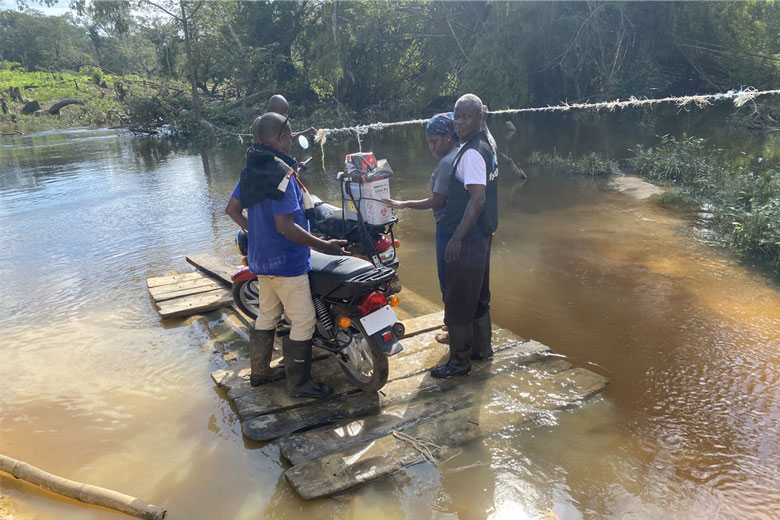
Familiarity might ease access, but that doesn’t make the distances any easier to traverse. Jerry Karn, who has been working as a vaccinator for the last 25 years out of Loguato clinic in Nimba County, shares Moore’s assessment of the major challenges of the job. He crosses a fast-flowing creek every time he goes out on outreach. “Rainy seasons can be worse,” he says.
There is no bridge: the crossing is done by raft. Karn holds on tightly to his motorbike, trying to protect his vehicle, himself, and the vaccine cooler from falling in a creek connected to the Cesto River.
His first stop is Zuoplay town, another area with almost impossible roads. He meets and greets the people in his own Gio dialect, calling on them to bring their children out for their vaccines. At the end of his visit, seven children and one pregnant woman receive their vaccines including HPV. And then it’s time to cross the river again.
“This work is just about sacrifice,” Karn says.
A sacrifice
Karn and Moore both number among the 44 “volunteers” working as vaccinators in Nimba. Unsalaried, they rely primarily on stipends provided during specific campaigns. Additionally, many volunteer vaccinators and CHWs in Liberia receive a transport stipend equivalent to about US$ 5 from Gavi, from whom they also receive rain gear and boots during the rainy season.
In the absence of support, vaccinators must find the means to fund the outreach themselves, either by purchasing their own gasoline or partnering with a health department staff member […] to go out for outreach.
Ophelia Woods, the County Child Survivor Focus Person, said last year the EPI, funded by Gavi, paid the incentives of 29 of the 44 volunteers working in the county. For the period covering August to December 2024, each volunteer received US$ 500, or US$ 100 a month. She added that similar support was provided this year. “But of the 26 people, 16 of them failed due to limited [mobile money] wallets.”
In the absence of support, vaccinators must find the means to fund the outreach themselves, either by purchasing their own gasoline or partnering with a health department staff member, such as the Community Health Service Supervisors (CHSS), to go out for outreach.
Woods acknowledged the challenges faced by volunteers, and says she is advocating for them to be put on the government payroll. In the meantime, however, she says she encourages them to keep on: their work is simply too important to stop.
This article was originally published on
VaccinesWork
Related Articles
Affordable Microscope Speeds Up Malaria Diagnosis with AI
The Octopi microscope autonomously analyzes blood samples in minutes, detecting malaria-infected cells among millions. Its creators hope it will accelerate the fight against malaria. From Stanford Report.
Last Mile Health: Bringing Healthcare to the Most Remote Communities
Last Mile Health transforms healthcare delivery in remote communities by training and paying local health workers, ensuring no patient is out of reach in Liberia, Ethiopia, Malawi, and Sierra Leone.
Last Mile Health: Bridging the Distance to Healthcare in the World’s Most Remote Communities
Last Mile Health transforms healthcare delivery in remote communities by training and paying local health workers, ensuring no patient is out of reach in Liberia, Ethiopia, Malawi, and Sierra Leone.