

In a country with the world’s second-oldest population and a long-standing reluctance to admit foreign workers, Japan’s care homes face a shortfall of roughly 570,000 caregivers by 2040, according to the labor ministry. There are nearly four open positions for every job seeker. Women over 40 fill more than seventy percent of those jobs; young men have long stayed away, deterred by low wages and a stubborn perception of care work as women’s labor.
Now, several Japanese operators have begun recruiting from an unlikely pool — bodybuilders, mixed martial arts fighters, and retired sumo wrestlers — and the results are starting to reshape the industry.
Bodybuilders

The most visible of these efforts belongs to Visionary Inc., a Nagoya-based disability welfare company founded in 2008 by Yusuke Niwa. Niwa had worked as a young male caregiver in his twenties and noticed he stood out simply because he was rare. A decade in, the company was struggling to hire even one carer a year.
In 2018, Niwa launched a recruitment campaign he called Macho Caregivers, built around a corporate bodybuilding team named 7SeaS — seven competitive lifters chosen for work ethic and “personality that garners support from those around them.”
Of Visionary’s roughly 340 caregiving staff, about 20 are bodybuilder caregivers. The 7SeaS members work six-hour caregiving shifts and get two hours of paid gym time daily, plus a monthly stipend of about 20,000 yen for protein, contest entry fees, and travel. Applications jumped from roughly ten a year before the campaign to an expected 1,200 this fiscal year. Visionary now operates 25 to 29 facilities and projects sales of 2.2 billion yen ($14.4 million) for the year ending March 2026, roughly ten times its pre-2018 revenue.

One of the Visionary caregivers is Hokuto Tatsumi, 27, a former Maritime Self-Defense Force serviceman who placed second in Japan’s largest amateur bodybuilding competition in both 2024 and 2025. Takuya Usui, 26, a former fitness trainer who bench-presses 170 kilograms, is another. Both work at a Visionary day facility in Ichinomiya, Aichi Prefecture, where they care for adults with disabilities.
MMA Fighters

In Kochi Prefecture, on the island of Shikoku, Mamiya Matsuura, 36, is both an active professional MMA fighter (featherweight, with a record of 3-3-1), and the operator of a nursing home his family has operated for years. In 2022 he began hiring professional MMA fighters who live and train at the facility.
Currently, ten fighters care for about fifty residents. Some have tattoos and dyed hair; they cook, help residents bathe, and train at night. “There’s a lot of testosterone in the room,” Matsuura told the New York Times. “But when it comes to taking care of the elderly, the fighters are very tender and very caring.” The residents, he said, have started treating the fighters like grandchildren.
Sumo

In Tokyo’s Sumida ward, not far from the national sumo arena at Ryogoku, Day Service Hanasaki is run by Keisuke Kamikawa. He is a retired wrestler who fought as Wakatenro and reached the Juryo 2 rank in 2010 before injuries forced him out at 33.
With no other job experience, Kamikawa took a high school equivalency exam, heard from an old classmate working in elder day care, and opened his first Hanasaki location in 2013. He now runs three.
His staff includes other former rikishi (sumo wrestlers), among them Shuji Nakaita, 44, and Yugo Miura, 38. The wrestlers’ training, Nakaita said, taught them to anticipate what’s coming next — a useful skill in caring for elders who may not be able to ask for what they need. Kamikawa has also begun mentoring other ex-wrestlers facing the long-standing problem of second careers after the ring. He has told reporters his aim is to make Hanasaki the “yokozuna” — the highest rank or grand champion of sumo wrestling — of Sumida-ku day services.
Shifting the Image
The wider picture is one of structural improvisation. Japan’s caregiver shortage forces roughly 100,000 people to leave their jobs each year to look after aging relatives. Another 300,000 are projected to be juggling work and home caregiving by 2030.
Some analysts note that physical strength alone doesn’t substitute for proper training in dementia care, communication, and patient safety. Therefore, athletes at these facilities work alongside conventionally trained staff rather than replacing them.
Still, the cultural shift — caregiving reframed as cool, strong, and visibly masculine — has begun to draw young men into a sector that had effectively been closed to them. These three small operations in Aichi, Kochi, and Tokyo show how the work itself can be reimagined.
This summary is based on the following sources:
- Japan’s New Care Workers: Bodybuilders, Wrestlers and M.M.A. Fighters, by Javier C. Hernández and Hisako Ueno for The New York Times (gift article)
- Bodybuilders find new calling in Japan’s struggling care industry, By Tomohiro Osaki for The Japan Times
Related Articles

Dr. Matt Oliva, Cure Blindness Project Board Chair, Wins Humanitarian Award
The American Academy of Ophthalmology (AAO) has selected Cure Blindness Project Board Chair and 27-year volunteer Dr. Matthew Oliva as recipient of its 2026 AAO Outstanding Humanitarian Service Award.
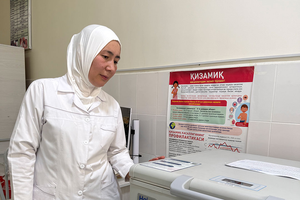
The Nurse Nurturing Vaccine Confidence in an Uzbek Mountain Exclave
In Shahimardan, nurse Nilyufar Tursunova says patient explanation of immunisation science is all nervous parents really need. From Gavi, the Vaccine Alliance and VaccinesWork.

Growing Up in Wartime Ukraine With a Rare Condition
Donated growth hormone is helping children catch up to their peers before time runs out. From Direct Relief.