The World Health Organization has declared the Ebola outbreak in the Democratic Republic of the Congo and Uganda, caused by the rare Bundibugyo strain for which no approved vaccines or treatments exist, a Public Health Emergency of International Concern. This post brings together the WHO’s emergency declaration alongside response updates from three humanitarian organizations with deep experience fighting Ebola:
- Direct Relief, which is mobilizing personal protective equipment and medical aid through partners in Goma and supporting preparedness across DRC, Uganda, and South Sudan
- ALIMA, which is deploying emergency medical teams and biosafe CUBE treatment units to Ituri Province, building on its 2025 Ebola response in Kasaï, and
- International Medical Corps, drawing on its extensive Ebola experience, including the 2014–2015 West Africa outbreak, to establish screening units, treatment facilities, and infection prevention training.
All three are working in close coordination with the WHO, the health ministries of the DRC and Uganda, Africa CDC, and a wider network of partners responding to one of the most challenging outbreaks in the region in years.
Summary of the announcement from the WHO
On May 17, 2026, the WHO Director-General declared the Ebola outbreak in the Democratic Republic of the Congo and Uganda, caused by the Bundibugyo strain of the virus, a Public Health Emergency of International Concern. The outbreak is centered in Ituri Province in eastern DRC, with international spread already documented in two unrelated travelers who tested positive in Kampala, Uganda.
WHO warns the true scope is likely much larger than reported, citing clusters of community deaths consistent with viral hemorrhagic fever, healthcare worker deaths suggesting nosocomial transmission, the urban character of the hotspot, ongoing regional insecurity, and a dense network of informal healthcare facilities. These conditions are reminiscent of the devastating 2018–19 North Kivu/Ituri epidemic.
Critically, unlike for Ebola-Zaire, there are no approved therapeutics or vaccines specific to Bundibugyo virus.
WHO is calling for activated emergency operations in both countries, intensified surveillance and contact tracing, strengthened infection prevention, community engagement through local leaders, exit screening at borders, and accelerated clinical trials, while explicitly warning against border closures and travel restrictions as counterproductive.
Learn more about Ebola from this Fact Sheet from the WHO.
Ebola Declared Public Health Emergency, Direct Relief Mobilizes Aid
Direct Relief received requests for personal protective equipment and other essential medical aid to protect and equip health providers caring for patients.
By Noah Smith
First published May 18, 2026 by Direct Relief
The World Health Organization has declared the Ebola outbreak in the Democratic Republic of Congo and Uganda a Public Health Emergency of International Concern as the number of suspected cases and deaths continues to rise across eastern Congo. Regional health authorities have reported 393 cases and 105 deaths in Ituri Province suspected to be linked to the Bundibugyo strain, for which no approved vaccines exist.
In its emergency declaration, WHO warned there are “significant uncertainties” surrounding the outbreak’s true scale and geographic spread, raising the possibility that transmission may be more extensive than current surveillance data indicates.
The outbreak, centered in northeastern DRC’s Ituri Province, has increased fears of wider regional spread in an area marked by frequent population movement, trade, and displacement across the DRC, Uganda, and South Sudan.
On Monday, the U.S. Centers for Disease Control and Prevention announced that public health travel restrictions were being put in place to limit entry from people who may have been exposed to the virus. An American doctor was confirmed Monday to have contracted the virus while treating patients at Nyankunde Hospital in Bunia, DRC.
How is Direct Relief Responding to the Current Outbreak?
Direct Relief is mobilizing medical aid for the DRC in coordination with Jericho Road Wellness Clinic in Goma, which has experience operating during prior Ebola emergencies in the region. Planned shipments include personal protective equipment and other supplies for clinics and displacement camps facing elevated outbreak risk.
Direct Relief has also offered support to the International Organization for Migration for Ebola preparedness and response activities in DRC, Uganda, and South Sudan. The organization continues coordinating with Africa CDC and regional partners to monitor evolving needs and response gaps as the outbreak continues.
Direct Relief has responded to multiple previous Ebola outbreaks across Africa, including the 2014 West Africa Ebola outbreak, during which the organization provided more than 420 tons of medicines and personal protective equipment to help protect frontline healthcare workers.
Ebola outbreak in the DRC: ALIMA deploys a response to the Bundibugyo variant
A new Ebola outbreak was declared on May 15, 2026, in northeastern Democratic Republic of the Congo. The outbreak involves the Bundibugyo variant,for which no vaccine or specific treatment currently exists. In response, ALIMA is mobilizing an emergency team, transporting supplies to Ituri, and strengthening prevention efforts in its other areas of operation.
First published May 19, 2026 by ALIMA
On May 15, 2026, health authorities in the Democratic Republic of the Congo officially announced a new Ebola outbreak in Ituri province, in the northeast of the country. This is the 17th Ebola outbreak recorded in the DRC. Two days later, the World Health Organization classified the outbreak as a public health emergency of international concern.
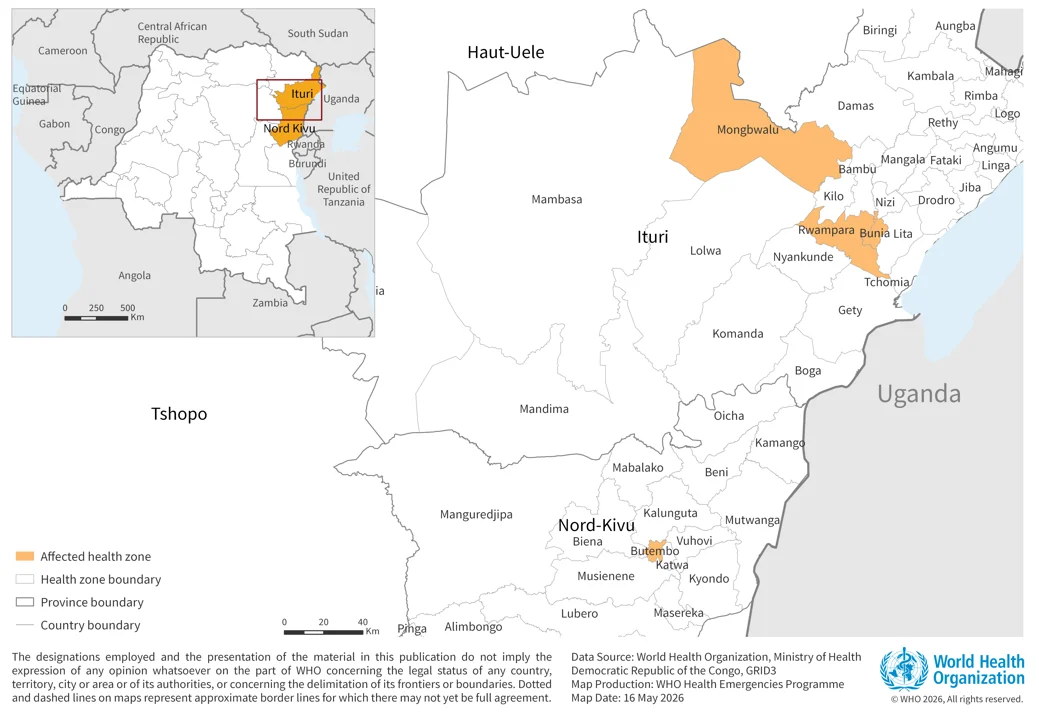
The outbreak is affecting several health zones, including Bunia, Mongbwalu, and Rwampara in Ituri province, near the borders with Uganda and South Sudan. This region experiences significant population movements due to mining activity, trade, and persistent insecurity. In recent days, cases have also been reported in the neighboring province of North Kivu, notably in Goma, Beni, and Butembo, as well as in Uganda. As a result, the outbreak has already spread beyond Ituri and the DRC. In total, 12 health zones are now affected: 9 in Ituri province and 3 in North Kivu. Health authorities are warning of a high risk of further transmission.
According to data released by the DRC Ministry of Health as of May 18, 2026, 401 suspected cases had been reported, including 303 in Ituri, along with 9 confirmed cases and 107 deaths. These figures, which are evolving rapidly, reflect the seriousness of the situation.
ALIMA’s rapid mobilization
Alongside Congolese health authorities, the WHO, and other mobilized actors, ALIMA is contributing to investigations and preparing to deploy a response in the affected areas.
An ALIMA team is already present in Bunia as part of its regular activities. At the same time, a first emergency team of 7 experts — doctors, nurses, and logisticians — is on its way to strengthen support to the DRC Ministry of Health.
ALIMA has also mobilized protective equipment, medical supplies, medicines, and CUBEs. These biosafe care units make it easier to treat patients while improving the protection of healthcare workers. The equipment is currently being transported to Bunia from Goma and Kinshasa.
This mobilization is part of ALIMA’s continued commitment to responding to Ebola in the DRC, following its intervention in Kasaï in 2025.
A particularly concerning outbreak
This new outbreak is caused by the Bundibugyo variant, a rare Ebola strain previously observed during two outbreaks in Uganda and the DRC. Earlier outbreaks linked to this strain had an estimated case fatality rate of between 30% and 50%.
Unlike the Zaire strain, for which vaccines and treatments exist, no approved vaccine or specific treatment is currently available against the Bundibugyo strain. The response relies primarily on rapid case detection, medical care, infection prevention and control, and community acceptance of public health measures.
In the early days of an outbreak, fear, the spread of rumors, and the time needed to build acceptance of certain measures can slow the response. Community trust and access to clear information are essential to containing the spread of the virus.
Immediate medical, logistical, and financial needs
Responding to an Ebola outbreak requires considerable resources. Specialized teams must be deployed quickly, specific protective equipment transported, and safe care facilities set up. Awareness-raising and protection measures must also be strengthened as close to communities as possible.
In Ituri, these needs are further intensified by security constraints, difficulties accessing certain areas, and population mobility, all of which can facilitate the spread of the virus.
The coming days will be critical in slowing the outbreak, caring for patients, and preventing wider transmission.
Present in the DRC for many years, ALIMA has proven experience in epidemic response.
Today, it is mobilizing alongside health authorities to help contain this new Ebola outbreak.
Support our teams’ work by donating today: Donate now
International Medical Corps is responding to Ebola in the DRC and neighboring countries
First published May 16, 2026 by International Medical Corps
On May 15, the World Health Organization reported an outbreak of the Bundibugyo strain of Ebola virus disease in Ituri province, Democratic Republic of the Congo (DRC). Since then, it has been reported in other provinces of the DRC, and there have been confirmed cases reported in Uganda. The Bundibugyo strain is not fully covered by vaccines developed that protect against the Zaire strain of Ebola—which was responsible for the 2014–2015 West Africa outbreak that killed more than 11,000 people—meaning it could be even more dangerous, since even vaccinated people are vulnerable.
The outbreak is especially concerning because it appears to have spread for several weeks before being recognized, meaning the current caseload may underestimate the true scale of transmission. It also is unfolding in a difficult context marked by conflict, population displacement and porous borders, increasing the risk of transmission of the disease.
International Medical Corps has already mobilized a rapid response team that includes trained medical staff, infection-control specialists, case management leads, and staff skilled in community engagement and supply-chain management. Drawing on our years of experience, we are working closely with the US Department of State, ministries of health and on-the-ground partners both within the DRC and in neighboring countries to procure critical supplies and provide the care and training needed to prepare for and fight this dangerous disease.
Fighting the Latest Outbreak of Ebola
In response to the latest outbreak of Ebola, our teams are supporting national authorities and partners throughout the region in their response. Drawing on our extensive experience, we are focusing on interventions critical to breaking transmission chains, including:
- establishing screening and referral units (SRUs) to rapidly identify suspected cases, triage patients safely and minimize transmission in health facilities and communities;
- operating Ebola Treatment Units (ETUs) to provide isolation, clinical care and supportive treatment for confirmed cases;
- supporting infection prevention and control (IPC) measures, including training frontline health workers in how to treat this highly contagious disease and ensuring access to personal protective equipment (PPE), clean water and modern hygiene infrastructure; and
- strengthening community outreach and surveillance systems to educate affected communities, facilitate early referral and to build trust in affected communities.
Given the challenges in accessing remote and conflict-affected areas, and the potential for this dangerous disease to spread even further if not contained quickly, a timely and coordinated response will be essential to contain the outbreak and protect vulnerable populations.
We are closely coordinating with public health authorities and international partners in the DRC and surrounding countries, and will continue to adapt our response as the situation evolves. Your support is critical to enabling rapid deployment and sustained operations in these high-risk settings.
Related Articles
In Tchunga, DRC, Motorbikes Facilitate Community Surveillance in the Ebola Response
Health teams supported by UNICEF use two wheels to verify alerts, trace contacts and conduct investigations in villages in the Democratic Republic of the Congo.
Young Community Volunteers Leading the Fight Against Ebola
Strengthening community acceptance and breaking the chains of transmission. From Gavi, the Vaccine Alliance and UNICEF
How a Peer Network is Mobilising Against Bundibugyo Virus in DRC and Uganda
As a rare strain of Ebola spreads in eastern Democratic Republic of the Congo, health workers and responders in affected communities are activating an established peer-learning network to bolster their response. From Gavi, the Vaccine Alliance
Great report