
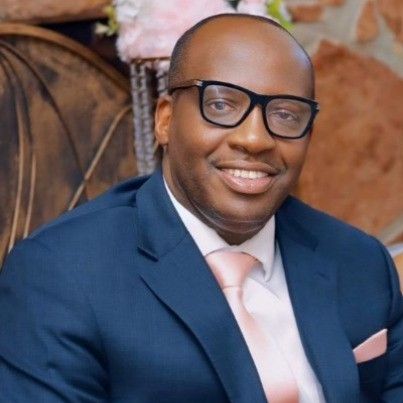
Jean de Dieu Mukunzi arrived in Dayton, Ohio, in 2008 with almost no English and only a bed at a local homeless shelter. He had left Rwanda “in search of peace and greater opportunities.”
He qualified for Medicaid, but the coverage was nearly useless to him: scheduling a doctor’s visit meant navigating an English-language phone system weeks in advance. When he got sick, he called 911 instead, at roughly seven times the cost of an office visit.
That gap between having insurance and being able to use it became the problem he’d spend the next two decades solving.
Mukunzi taught himself English in four months, using library CDs and DVDs, then enrolled at Wright State University’s Boonshoft School of Medicine for a Master of Public Health degree. His 2011 thesis on refugee health needs in Montgomery County became the blueprint for an organization of his own. His plan called for a multilingual hotline, culturally vetted medical information, and home visits after hospital discharge.

It took most of a decade to build it. Mukunzi worked at CareSource, then with Public Health–Dayton and Montgomery County, then at Ohio State’s Wexner Medical Center, before founding Ebenezer Healthcare Access in 2019. Today it operates in Dayton, Columbus, and Cincinnati, with 32 community health workers fielding a hotline in 16 languages. Last year it served more than 2,800 clients, logging over 37,000 individual “pathways,” discrete services like Medicaid enrollment, transportation, and home visits to make sure discharge instructions are understood.
As Mukunzi put it on the Ebenezer website, the goal from the start was building “a community where every individual…has equitable access to health information, preventive care, and the opportunity to thrive.”

He’s not finished. Mukunzi is now working with researchers at Harvard to study whether this model could scale nationally, and eventually internationally, to help refugees elsewhere navigate unfamiliar health systems.
Sara Paton, a Wright State epidemiology professor who taught Mukunzi as a student and later joined Ebenezer’s board, has watched the arc from the beginning. She told the Wright State University newsletter, “It speaks to how far he has come himself, from the person that was struggling to speak English and to find a place in our country, and now he’s mentoring and inspiring the next generation of public health professionals.”
This summary is based on the following sources:
- From a homeless shelter to a healthcare lifeline, by Bob Mihalek for Wright State University Newsroom
- Ebenezer Healthcare Access
- Bio on Dayton, Ohio official website
Related Articles
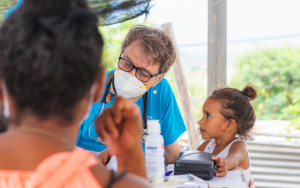
MedGlobal Improves Access to Healthcare to Migrants in Colombia and Ecuador
“The migrant crisis is a reality not only in the US but also in many central and Latin American countries with much fewer resources. We are doing our part by improving access to dignified health and reducing the burden on the overwhelmed healthcare systems in Ecuador and Colombia.”
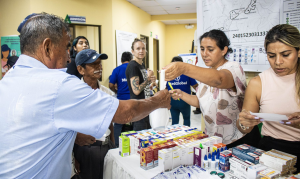
Updates from MedGlobal’s Work in Latin America
The 2013 collapse of the Venezuelan economy and its political institutions has produced a crisis affecting all of Latin America, growing into the largest migration crisis in the Western Hemisphere. In response to the crisis, MedGlobal has established a number of programs in both Colombia and Ecuador.

UIC Medical Students, Doctors Provide Migrant Care
As more migrants were making their way from the border to the Chicago area, a group of University of Illinois Chicago medical students formed the Mobile Migrant Health Team to provide care for them.