
Dr. Jeffrey Young, retired trauma surgeon, traveled to Ukraine to train military doctors in emergency procedures, bringing expired medical supplies and three decades of expertise to a country innovating under wartime pressure.
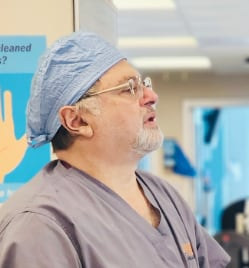
Dr. Jeffrey Young stood silent in Vinnytsia, Ukraine, as the 9 a.m. national anthem played—a daily ritual honoring the dead in a country that has endured over three years of full-scale war. The retired trauma surgeon from Charlottesville had traveled thousands of miles to share what he knew about saving lives under impossible conditions.
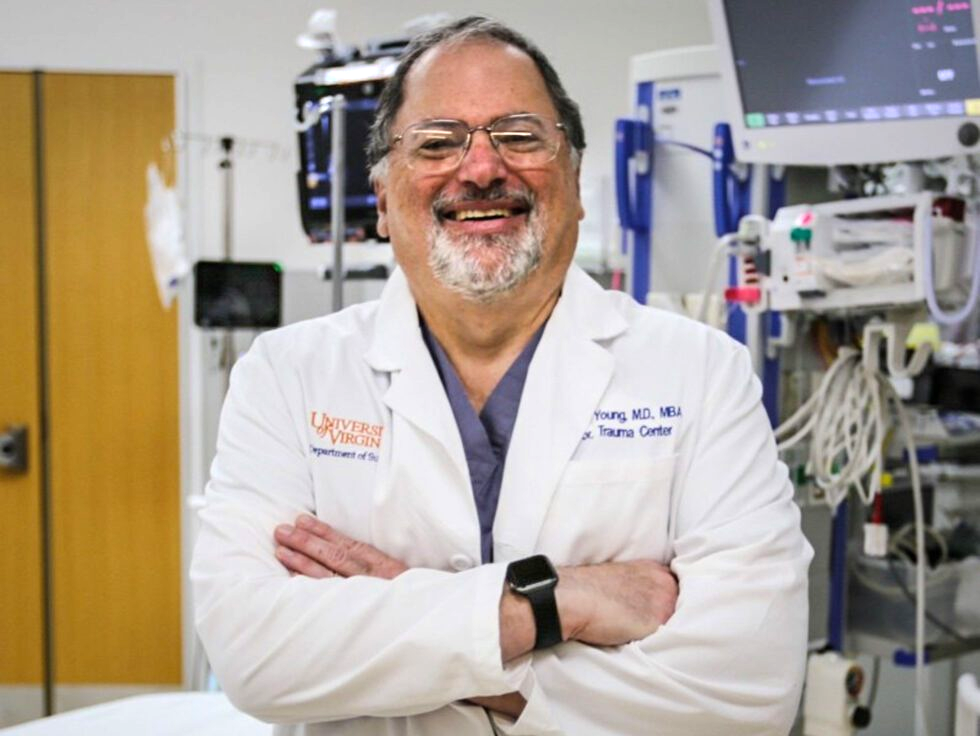
Young spent 30 years building UVA Health’s trauma center from nearly nothing into a fully functioning program. He served as Chief Quality Officer and Chief Patient Safety Officer and spent fourteen years with the U.S. National Disaster Medical System. When he retired in December 2023 as Professor Emeritus, he knew humanitarian work was next.
Breaking into humanitarian surgery proved difficult. Young completed the Hostile Environment Surgical Training Course with the David Nott Foundation in London, where he met MedGlobal board member Mike Samotowka. A month later came the invitation to Ukraine.
Training Under Pressure
In Vinnytsia, hundreds of kilometers from active combat, Young spent four days training approximately 20 military surgeons preparing for deployment. The group practiced emergency procedures on animal tissue, including repairing lungs, controlling bleeding, and removing spleens and kidneys.
“Trauma is trauma,” Young told RVA Magazine. “You learn to stabilize, improvise, and act fast. You don’t have the luxury of waiting for everything to be perfect.” His teaching emphasized a crucial principle: “Perfect is the greatest enemy of good.”
The training faced limitations. Animal tissue couldn’t replicate smaller limb and neck vessels, which would require cadavers. Young improvised with resources, including 20 pounds of expired materials from UVA that were “useless on humans, perfect for training”.
By week’s end, five surgeons had trained roughly 80 Ukrainian clinicians. Young acknowledged the limitations: “You can’t expect to be an expert after a day. But if you’ve seen it once, done it once, maybe you’ll remember what to do when it really matters.”
Innovation Born from Necessity
The Ukrainian medical response has generated innovations that Young believes will reshape civilian emergency care. Medical teams now drop blood by drones into trenches and have converted SUVs for medical evacuation because ambulances proved too visible to enemy drones.
With helicopter evacuation largely impossible, Ukraine has developed what Young describes as prolonged casualty care. Frontline medical personnel are taught to keep patients alive for one to three days, not just stopping bleeding but fighting infections, giving blood, performing wound care, and even conducting limited surgery near the front.
“If something works, they use it,” Young observed. “If it doesn’t, they change it tomorrow. That adaptability is keeping people alive.”
The daily teaching required constant adaptation. Power outages, missing materials, and groups with varying experience levels demanded flexibility. For Young, this unpredictability became valuable. “It’s good for me,” he said.
Young envisions broader applications for Ukraine’s innovations, suggesting bringing Ukraine’s adaptability into NATO training for smaller countries like Latvia, Lithuania, and the Balkans.
Looking Forward
Young’s humanitarian work continues. In January, he deploys to Sierra Leone with Mercy Ships for three weeks of civilian surgery. Sierra Leone has approximately one surgeon for every 50,000 people, making routine procedures like hernia repairs transformative.
He maintains his work through short-term locum shifts in Virginia, keeping trips financially sustainable.
His philosophy reflects lessons from both his career and recent deployment: “If I operate, I can help five or six people. If I train twenty surgeons, they can help hundreds. That’s the multiplier.”
This summary is based on the following article:
- How a Charlottesville Surgeon Found Purpose in Ukraine, by R. Anthony Harris for RVA Magazine
Related Articles
The Organizations Giving Ukraine’s Amputees Their Lives Back
In Lviv, two extraordinary organizations — Superhumans and Unbroken — have turned the tragedy of 100,000 amputations into a global model for what rehabilitation medicine can be.
‘Medicine in Its Purest Form’: Saving Limbs in Ukraine’s Hospitals
Penn-led medical missions have performed complex surgeries, extended training to local doctors in attempt to preserve limbs and quality of life. From Direct Relief.

Global Relief in Focus: 10 Images that Defined Humanitarian Aid in 2025
2025 was a year filled with conflict, disaster and disease—as well as the work of committed and courageous humanitarians who did everything they could to help. These photos from International Medical Corps highlight the people who made it happen.